
Main Campus
Managua
Institutional core, rectorate, the Schools of Government, International Affairs, Law, and Engineering & Sustainable Infrastructure.
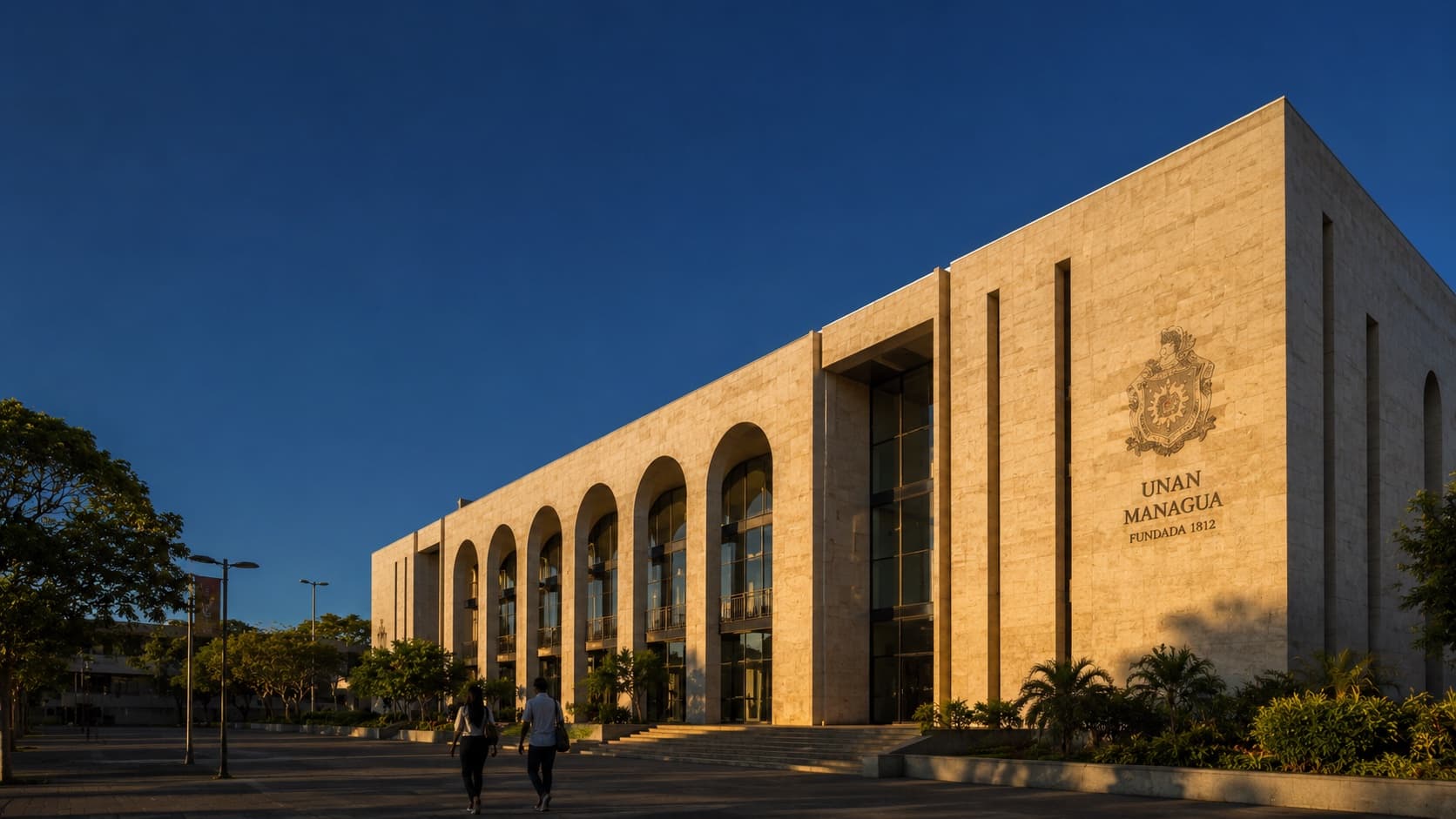
Nicaragua International Government Administrational University (NIGA) was chartered in 2026 as Nicaragua's first university dedicated to the study of governance, public administration, and international affairs. Founded by an act of the National Assembly and ratified through a multilateral cooperation agreement with regional partners, NIGA was established to address a generational need: the formation of public servants, diplomats, and technical specialists capable of stewarding Nicaragua's institutions, resources, and international relationships through the twenty-first century.
The University's main campus rises in Managua, with satellite campuses in León and Granada extending its reach into the country's historic centers of learning and civic life. NIGA operates under an international charter that opens its classrooms to students from across the Americas and beyond. While public administration anchors the institution's identity, NIGA is a comprehensive university — encompassing law, engineering, the sciences, business, the humanities, health, education, and agriculture — and its degrees are designed to meet international accreditation standards.
NIGA University prepares principled public servants, scholars, and professionals to advance the institutions, infrastructure, and international standing of Nicaragua and the wider region. Through rigorous, interdisciplinary education grounded in the humanities, the sciences, and the practice of governance, the University equips its graduates to confront the most consequential challenges of their era — from democratic renewal and economic development to the stewardship of water, land, and human dignity — with competence, integrity, and a commitment to the common good.
To be the preeminent institution in Central America for the study of government, international affairs, and the sustainable management of natural resources — a university whose graduates lead ministries, draft treaties, design infrastructure, and advance the public interest from Managua to the wider world, and whose scholarship shapes the policies of nations.
Chartered by the Republic of Nicaragua and structured to welcome students, faculty, and partnerships from across the hemisphere and beyond.
The Water Resources Management program convenes engineers, policy scholars, and ecologists around the freshwater systems that will define the region's future.
Every school is built around the conviction that scholarship serves society — curricula shaped in dialogue with ministries, courts, and international bodies.
Managua's institutional core, León's intellectual tradition, and Granada's civic heritage form a distinctive learning environment unmatched in the region.
Institutional core, rectorate, the Schools of Government, International Affairs, Law, and Engineering & Sustainable Infrastructure.
Historic intellectual capital of Nicaragua. The Schools of Arts, Humanities & Letters and the Sciences.
Colonial city on Lake Cocibolca. The Schools of Business & Economics and Agriculture & Environmental Studies; major field stations for the flagship water program.
Founding Chancellor Dr. Elena Sandoval and Provost Dr. Rafael Pérez-Mendoza lead the University's strategic vision and academic policy.