
Director of the Water Resources Management Program
Dr. Lucía Beatriz Aguilar Rocha
Ph.D. in Civil and Environmental Engineering, Stanford University
Integrated watershed modeling and the hydrology of tropical lake systems.
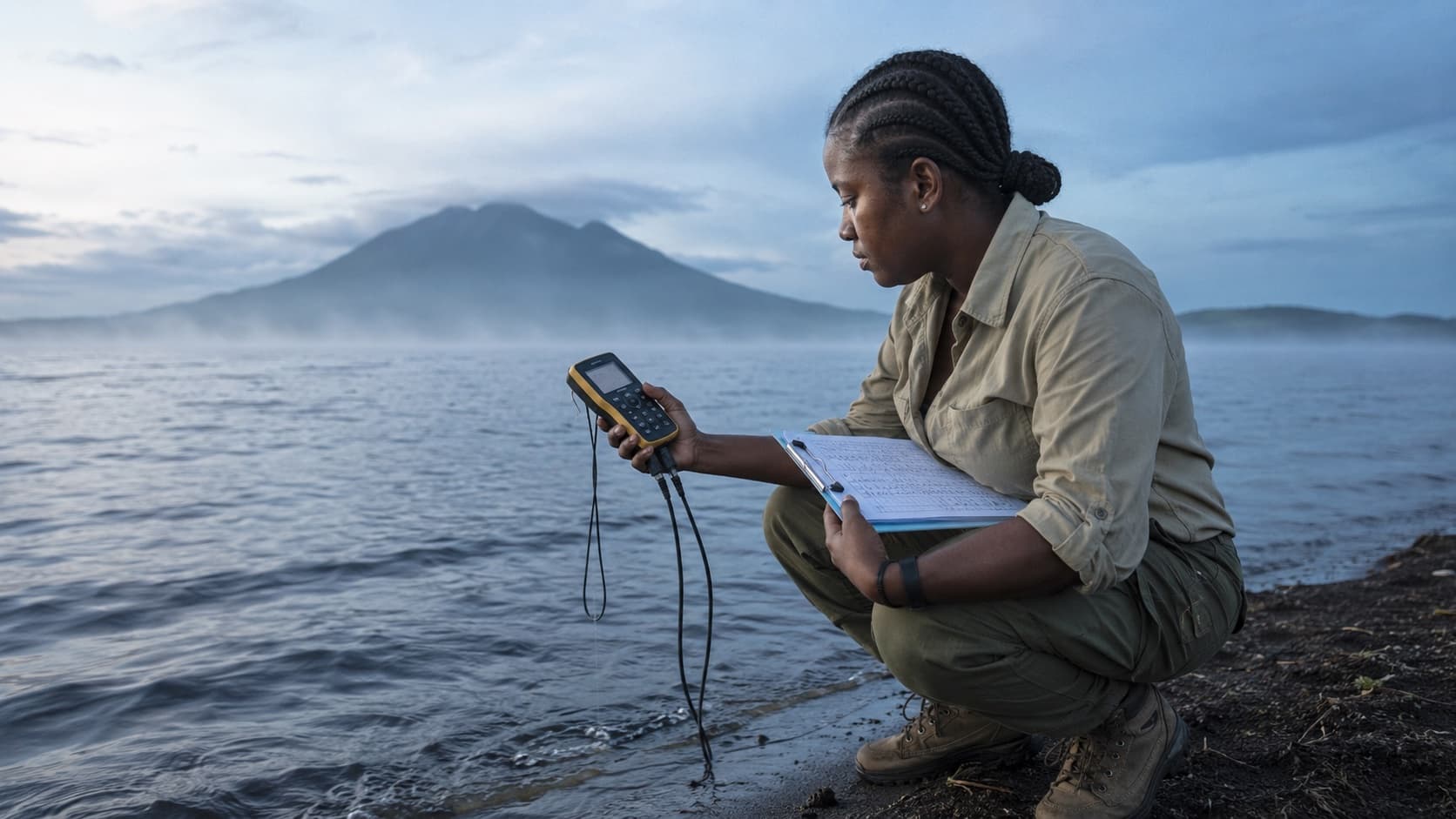
The interdisciplinary degree at the heart of NIGA's founding mission — engineering, policy, and environmental science converging on the freshwater systems that will define Central America's coming decades.
Water Resources Management is the flagship program of NIGA University and the academic centerpiece of the institution's founding mission. The program was designed in consultation with the Ministry of Environment and Natural Resources, the Autoridad Nacional del Agua, and a consortium of regional research institutions, with a single conviction at its heart: that the responsible stewardship of Nicaragua's freshwater systems is the defining civic, scientific, and economic challenge of the coming century.
The curriculum is rigorously interdisciplinary. Students move between the laboratory and the policy seminar, between fluvial geomorphology and transboundary water law, between hydraulic engineering and environmental economics. Graduates emerge with the capacity to model a reservoir, draft a watershed management plan, negotiate a binational accord, and explain the trade-offs of each to a minister or a community assembly.
Anchoring the program's identity is Lake Cocibolca — Lake Nicaragua — the largest freshwater body in Central America, and one of the most consequential and contested freshwater systems on the isthmus. Field instruction extends to the Río San Juan, the highland watersheds of Jinotega and Matagalpa, and the Pacific coastal aquifers.
Principles of the hydrologic cycle, precipitation, evapotranspiration, runoff, and groundwater recharge.
Physical and ecological foundations of watershed function, basin delineation, and integrated catchment analysis.
Frameworks for water governance, regulatory institutions, and the political economy of resource allocation.
Valuation of natural assets, externalities, and economic instruments for environmental management.
Spatial data, remote sensing, and GIS-based analysis of hydrologic and infrastructure systems.
Unit processes in potable water treatment, wastewater management, and sanitation infrastructure design.
Design, operation, and policy of irrigation, drainage, and on-farm water management.
Public international law of shared rivers, lakes, and aquifers — case studies including the Río San Juan.
Hydrologic implications of climate change, adaptive management, and resilience planning.
Chemical, biological, and physical parameters of water quality, with applied monitoring and modeling.
Integrated design of reservoirs, distribution networks, and nature-based water infrastructure under uncertainty.
Advanced seminar on the science, history, and governance of Lake Nicaragua and its watershed.
Faculty-led seminar on national and regional water security strategies, with guest practitioners.
Computational modeling of surface and groundwater systems for planning and operations.
Year-long applied project conducted in partnership with a ministry, agency, or community partner.
Ph.D. in Civil and Environmental Engineering, Stanford University
Integrated watershed modeling and the hydrology of tropical lake systems.
J.S.D., Yale Law School
International water law and the governance of shared freshwater resources in the Americas.
Ph.D. in Environmental Engineering, ETH Zürich
Water treatment systems and sanitation infrastructure for low- and middle-income contexts.
The degree opens doors across the public, multilateral, private, and research sectors that govern and steward water in the Americas.
Senior technical and policy roles within the Ministry of Environment and Natural Resources and the Autoridad Nacional del Agua
Programme officer and specialist positions with UN-Water, UNESCO-IHP, and the United Nations Environment Programme
Water sector economists and project leads at the World Bank, the Inter-American Development Bank, and the Central American Bank for Economic Integration
Senior consultants at international engineering and environmental consultancies serving public and private water clients
Programme leadership at NGOs working on watershed conservation, rural water access, and climate adaptation
Research scientists in national laboratories, universities, and international research consortia
Advisory roles in transboundary river commissions and regional water cooperation bodies
Nicaragua holds an extraordinary inheritance of fresh water — Lake Cocibolca, Lake Xolotlán, the Río San Juan, the Coco, the Escondido, the great Caribbean lowland rivers, and a network of highland watersheds that sustain agriculture, hydropower, and millions of households. That inheritance is also a responsibility. Climate variability, agricultural intensification, urban expansion, and unresolved questions of transboundary management make the careful stewardship of these systems the defining policy challenge of the country's coming decades. Nicaragua has the opportunity to lead Central America in setting the standard for how a nation governs, protects, and develops its waters — and NIGA exists, in part, to prepare the women and men who will exercise that leadership.
Applications for the inaugural cohort of the Water Resources Management program are open through 15 June 2026. Decisions released by 15 July 2026.